Deadline for Submitting Panels and Individual Abstracts for LASS2016 Conference has been extended to 1 MARCH 2016.
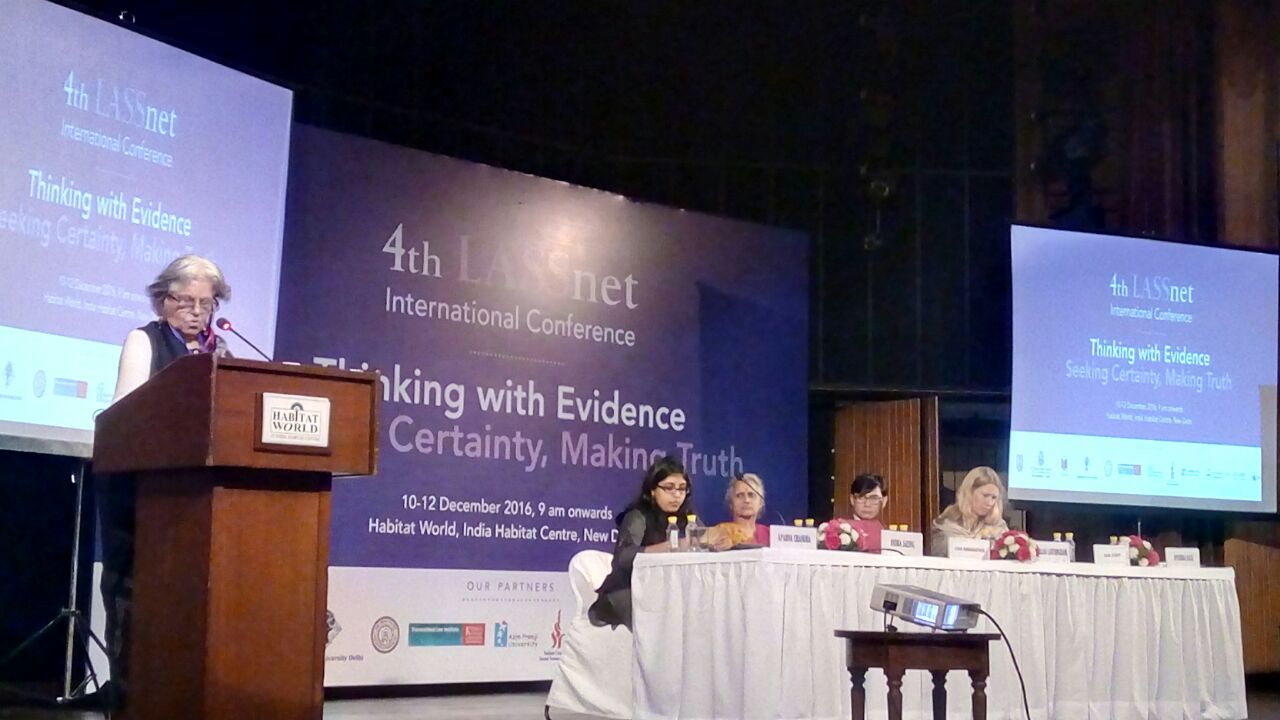
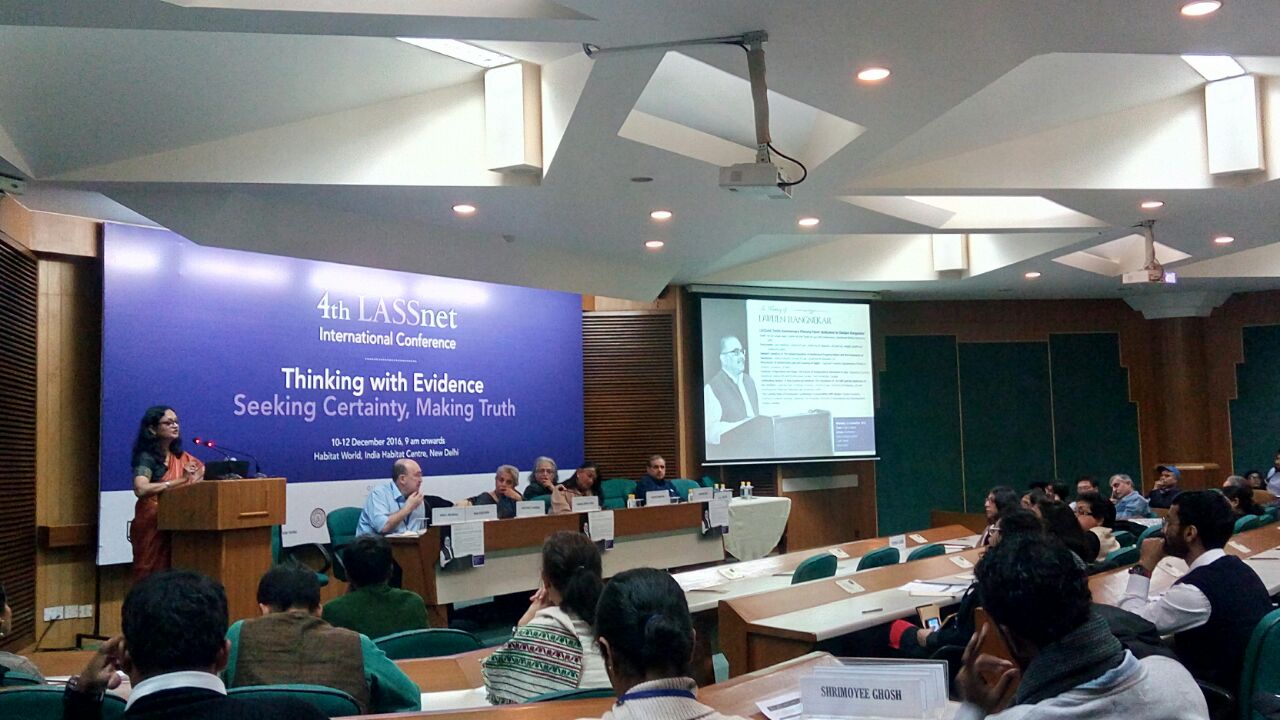
LASSnet Conference- 10-12 December 2016
‘Thinking
with Evidence: Seeking Certainty, Making Truth’.
The indeterminacy in law could be read both as a problem of truth and also
as one that plagues disciplines. The question of evidence has been central to
the formation of disciplines and the claims that they make upon knowledge. For
initiatives such as LASSnet, the imperative of thinking with evidence — in
these times of virtual virality, forensic imaginaries and ephemeral archives —
serves as a fertile ground on which we can stage discussions of the perils,
pleasures, meanings and methods of inter-disciplinarity. While disciplines are
defined partially by the evidentiary protocols that they follow, the very
nature of inter-disciplinary enquiry calls into crisis the idea of a single
protocol. The methodological concerns with the seeking and making of certainty
and truth implicate a whole range of disciplines: anthropology, art, history,
law, religion, philosophy, politics, economics, literature, theatre, and
science, to name just a few. The stakes in thinking with evidence are very high
since doing so raises the core epistemological claims, regarding not just of
what, but also how we know. This is rendered all the more difficult because the
very grounds of evidence are themselves shifting terrain, subject not only to
developments in science and technology but also to forms of historical
consciousness and social knowledge.
Thinking with evidence in engaging the encounters and intimacies between the
imaginations of the legal and the social can provoke interdisciplinary
conversations, in the affective and corporeal works and worlds of making,
seeking and living with truth. Such an engagement offers an invitation to
re-invigorate discussions around the dialectic of the abstract and the concrete
of jurisdiction, procedure and techné.
How does evidence index intelligibility and illegibility simultaneously on
bodies and things? How are questions of inheritance and memory mediated through
a claim to the evidentiary? How may one think of ways of doing politics and
living with law? Or address questions of responsibility and conduct,
particularly as these arise in the context of experience, acting as evidence of
legitimate speech?
The English word ‘evidence’ is associated with Latin verb, vidier, to see.
The relationship between seeing, believing and knowing, when mediated by visual
technologies, transforms ways of seeking certainity and making truth. Along
with criminal law, procedural and constitutional law also offer fertile grounds
to think of evidence as an object of truth and power. In our technologized
regimes that are heavily invested in the forensic fascination with truth
detection, how do we think of the constitutional implications of scientific
evidence and the truth claims that they make?
Moreover, why is the ocular or aural privileged over the haptic or
olfactory? How do we furnish evidence of experiences of humiliation when ocular
or aural techniques of knowing and telling make suffering illegible in the
legal languages of evidence? Moving our gaze to the gamut of categories that
populate ‘evidence law’ we ask following William Twining: “how to do things
with evidence?” Is it a legal fiction that there are evidentiary rules that
determine probability, presumption, fact, proof and certainty, classifying some
artefacts as facts or truths and others as exaggerations, falsehoods or myths?
How is the process of making juridical facts, legal certainties and
presumptions embedded in continuities and changes in social relations in
history, economy, culture and politics? How does the production and circulation
of technologies of evidence in popular culture create demands for scientific
evidence in actual trials?
What kind of commodity is evidence? What kinds of technologies are deployed
to evidence the body in law? What kinds of knowledges congeal in the category
of expert evidence, from archealogy to forensics, to act upon languages of
social suffering? What is the nature of the testimony that underlies expert evidence
in law and literature? Do concepts of evidence in visual arts and performing
arts speak to juridical notions of evidence, testimony and witnessing?
How may we understand what we do with evidence when we turn to religion, or
custom; or state and non-state law? Drawing on the vast critical literature on
Hindu or Islamic law; or customary and indigenous law in colonial,
post-colonial and settler-colonial contexts, how may one think of evidence as
it mediates between law and justice in relation to the claims of truth to
power? How are notions of evidence in these traditions, or in traditions of
aurality/orality, constituted by the theories of codified visuality in common
law traditions? Further, what kinds of evidence does the discourse on
plurality, secularism and rights rely upon?
Why do certain kinds of evidence of suffering falter, while other kinds of
evidence succeed in making suffering visible? How do we think of evidence in a
broad sense—as not just documents, facts, proof, or expert knowledge but also
as "aesthetics of protests'', as truths that counter the processes by
which evidence is constructed in the context of of displacement, gender
violence, caste humiliation, mass violence, disappearances and/or state terror?
When certain facts are banished from courts of law, how do the politics and
aesthetics of protests furnish evidence of truth to power? How does the regime
of evidence produce marginalities and exclusions from collective memory and
historical record? What kind of residue resides in the legal archive that
allows us to describe how law is haunted by unwritten precedents of injustice?
In other words, how does evidence actualise the separation of law from justice?
Call For Papers| Conference Sub-Themes| Instructions
for Submission
Conference Sub-Themes
Histories of Evidence/ Evidence of History
Evidence and Affect
Evidence and Absence
The Art and Architecture of Evidence
Evidence in/ as the Archive
Evidence and its Corporealities
The Work of Evidence in State-building
Memory and Museums/ Curating Evidence
The Markets of Evidence
Rival Jurisprudences of Evidence
The Evidence of the Body/Body of Evidence
Jurisdictions of Evidence
Indicators, measurements and evidence
Evidence, governance and policy-making
Scientific Evidence and the Making of Juridical Truths
Identity (Political, Social and Juridical) and Evidence
Others
In keeping with the eclectic spirit of LASSnet, we welcome submissions that
address concerns of the LASSnet broadly in connection with the theme of the
conference, including papers, panels, and presentations on the sub-themes
detailed above. To mark the completion of 10 years of LASSnet in 2017, we plan
to bring out a series of edited volumes and/or special issues in journals in
2017-2018. Book proposals or journal special-issues plans will be a priority in
this edition of LASSnet. We strongly encourage participants to think of panels
as potential volumes. The steering committee will actively organise
conversations around publication plans and any one willing to organise
pre-conference workshops is welcome to get in touch with us.
Instructions for submission of papers
In keeping with the eclectic spirit of LASSnet, we welcome submissions that
address concerns of the LASSnet broadly in connection with the theme of the
conference, including papers, panels, and presentations on the sub-themes
detailed above. To mark the completion of 10 years of LASSnet in 2017, we plan
to bring out a series of edited volumes and/or special issues in journals in
2017-2018. Book proposals or journal special-issues plans will be a priority in
this edition of LASSnet. We strongly encourage participants to think of panels
as potential volumes. The steering committee will actively organise
conversations around publication plans and any one willing to organise pre-conference
workshops is welcome to get in touch with us.
We welcome proposals for panels as well as for individual paper presentations.
Panel proposals: Panel coordinators should submit a panel description of 500
words as well as a proposed list of panelists (ideally no more than four
speakers per panel, including the chair-discussant) via online submission link
below (more details below). The panel description should be accompanied by
individual paper proposals for each panelist, following the instructions below.
Coordinators may also choose to propose a chair—discussant for the panel as a
whole.
Individual papers: Paper abstracts (500 words maximum) should be submitted
via online submission link below. Please note that abstract/papers should not
be sent through email.
Online Submission Link: To submit Individual abstract you will have to :
i) Register as Author on submission website. Please refer to this document for
step by step procedure
ii) Login to submission website using credentials received during step i, and
upload an abstract in '.doc' or '.pdf' format along with additional
information. Please refer to this document for detailed guidelines
You can directly go to Abstract Submission Website if you have registered
yourself as an Author (step i. above), and read the guidelines for abstract
submission detailed in step ii above.
In case of Panel submissions:
iii) Panel coordinator must first submit the panel details through abstract
submission link (see step ii) with the difference that - instead of uploading
abstract you will upload a '.doc' or '.pdf' file containing panel description
and the list of panelists; and click on 'Panel abstract' box instead of
'Individial abstract' checkbox in the additional questions section (question
number 1) of the abstract submission link.
iv) All panel authors will also submit their paper abstracts through abstract
submission link (see step ii) with the difference that - they will click on
'Panel abstract' checkbox and provide name of the panel coordinator (question number
6) in the additional questions section of the abstract submission link.
Abstracts (Individual/Panel) should be submitted no later than 1st March
2016
We will get back to you
within eight weeks of receiving the abstract or
paper proposal. If an abstract is accepted for the conference, a full draft
paper should be submitted to the conference secretariat by
30 October 2016
(using Online Paper Submission Link to be made available) and distributed to
the discussant and fellow panel members no later than
15 November 2016. In the
case of pre–formed panels, this will be the responsibility of the Panel
Coordinator.The maximum duration of individual presentations within each panel
will be 20 minutes.
Contact the LASSnet 2016 Steering Committee at lassnetconf2016 [at] gmail
[dot] com
To join LASSnet please write to lassnet [at] gmail [dot] com
Other information will be announced in due course at LASSnet blog
/ www.lassnet.org
and our facebook page
here.
.jpg)